The topic is short and compact
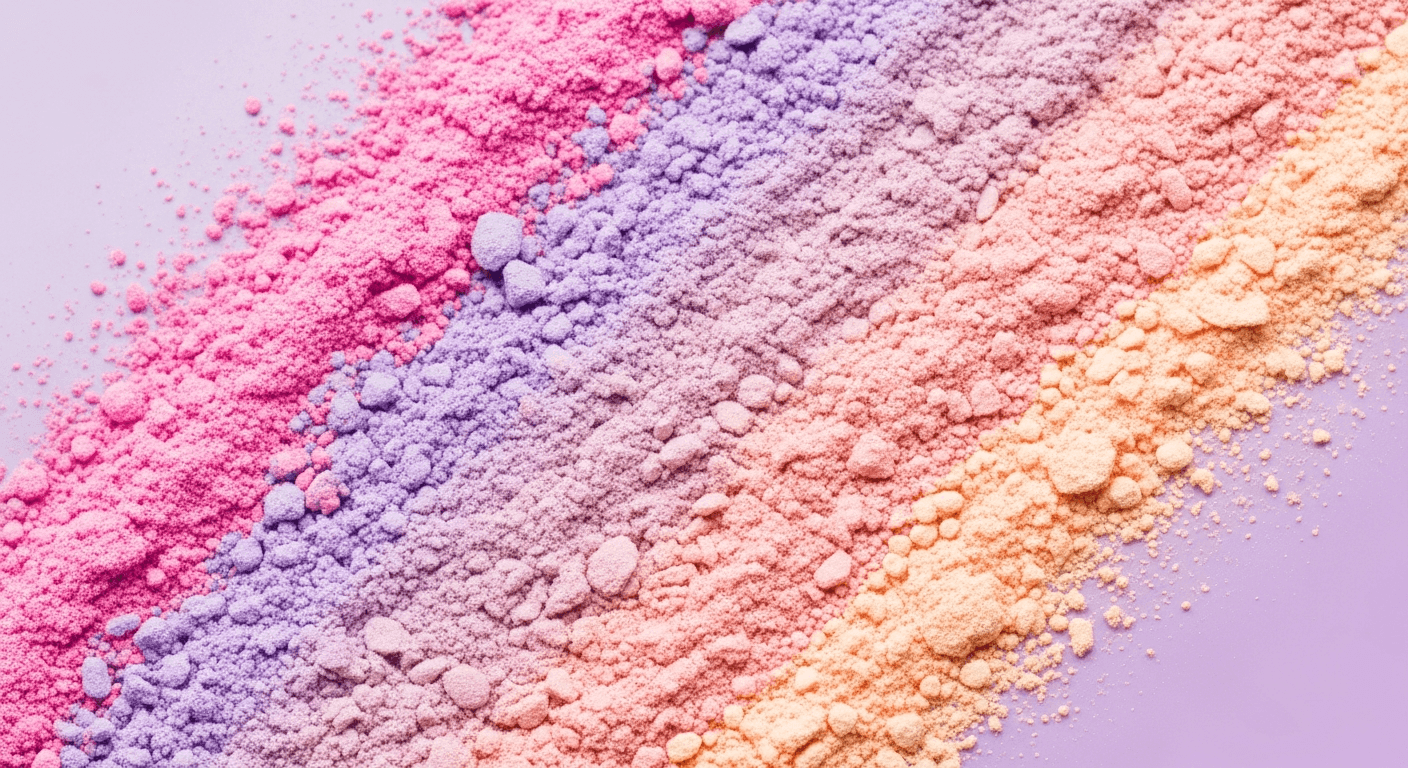
Almost every complexion shade is created from four basic pigments: titanium dioxide and three iron oxides in yellow, red, and black.
Undertones must be defined before the first formulation because they determine the structure of the entire series.
Color drift in series production is usually caused by incomplete pigment dispersion, not by incorrect formulation.
So läuft die Entwicklung bei Labtree
1
Konzeptionierung
2
Bemusterung – Standardmuster in 24 h
3
Individualisierung
4
Prototyping
5
Produktion
White Label 2–3 Monate · Private Label 3–6 Monate · Produktion ab 1.000 Stück
Every complexion shade, from the lightest foundation to the deepest concealer, is created from a surprisingly small palette of pigments. In practice, almost the entire range is based on four mineral pigments: titanium dioxide for coverage and brightness, and iron oxides in yellow, red, and black for depth and tone. The art of shade development lies not in the number of raw materials, but in the precise control of their ratios and their distribution in the formulation.
Titanium dioxide significantly determines coverage. A high proportion creates an opaque but potentially chalky appearance, while too low a proportion leads to sheer shades without coverage. At the same time, titanium dioxide causes the so-called flashback effect, where the pigment reflects camera flash and makes the face appear pale in photos. Managing this effect requires combining different particle sizes and surface treatments, which must be tested in the dedicated laboratory early on during formulation development.
Titanium dioxide: determines coverage, brightness, and the risk of flashback under flash photography.
Yellow iron oxide: carries the warm undertone that the majority of skin tones require.
Red iron oxide: controls pink and peach tones and thus the perceived subtype.
Black iron oxide: regulates depth and saturation, and has an extremely strong effect even in the smallest amounts.
Crucially, these pigments exhibit different densities and wetting behaviors. Black iron oxide is effective in fractions of a percent, whereas titanium dioxide is used in double-digit percentage ranges. This spread makes exact dosing and uniform dispersion the actual technical challenge, long before sensory profile or packaging is discussed.
The steps Labtree takes in this process and what the timeline looks like can be found in the cosmetics development process.
The Chemistry of Nuance: Mineral Pigments and Opacity
Every complexion shade, from the lightest foundation to the deepest concealer, is created from a surprisingly small palette of pigments. In practice, almost the entire range is based on four mineral pigments: titanium dioxide for coverage and brightness, and iron oxides in yellow, red, and black for depth and tone. The art of shade development lies not in the number of raw materials, but in the precise control of their ratios and their distribution in the formulation.
Titanium dioxide significantly determines coverage. A high proportion creates an opaque but potentially chalky appearance, while too low a proportion leads to sheer shades without coverage. At the same time, titanium dioxide causes the so-called flashback effect, where the pigment reflects camera flash and makes the face appear pale in photos. Managing this effect requires combining different particle sizes and surface treatments, which must be tested in the dedicated laboratory early on during formulation development.
Titanium dioxide: determines coverage, brightness, and the risk of flashback under flash photography.
Yellow iron oxide: carries the warm undertone that the majority of skin tones require.
Red iron oxide: controls pink and peach tones and thus the perceived subtype.
Black iron oxide: regulates depth and saturation, and has an extremely strong effect even in the smallest amounts.
Crucially, these pigments exhibit different densities and wetting behaviors. Black iron oxide is effective in fractions of a percent, whereas titanium dioxide is used in double-digit percentage ranges. This spread makes exact dosing and uniform dispersion the actual technical challenge, long before sensory profile or packaging is discussed.
The steps Labtree takes in this process and what the timeline looks like can be found in the cosmetics development process.
Creating a harmonious range of nuances: undertones and structure
A shade range is not a set of individual colors, but a system. Before the first formulation is developed, the structure of the range must be established: How many brightness levels should there be, and which undertones will be covered per level? A matrix of brightness levels and cool, neutral, and warm undertones is standard. If this structure is defined only after the fact, gaps or duplications will occur, which can later only be resolved by a complete redevelopment.
The undertones determine the ratios of the iron oxides to one another. A warm undertone shifts the ratio in favor of yellow, while a cool undertone increases the red content and reduces yellow. Neutral tones lie in between and, experience shows, are the most difficult to hit stably, because even minor deviations are perceived as too pink or too yellow. For brands that want to have a foundation produced, this preliminary work is the most important lever for subsequent market success.
Brightness axis: defines the number of levels and the spacing between them, so that no visible gaps occur.
Undertone axis: determines which undertones are offered per brightness level.
Spacing logic: The difference between adjacent shades must be large enough to be distinguishable and small enough to allow for transitions.
This system also determines economic efficiency. Each additional shade means a separate production batch, its own minimum order quantities, and its own warehousing. A well-designed range therefore covers as broad a spectrum as possible with as few shades as possible, instead of stocking many barely distinguishable variations.
Color matching: From reference to production recipe
Matching a target shade is no longer done purely visually today. Visual assessment depends on lighting, surrounding colors, and the individual, making it non-reproducible. Instead, shades are captured spectrophotometrically and described in measurable color values. This allows the deviation between the target and the sample to be expressed as a number and targeted for correction, rather than being discussed.
It is important to note that a shade must not be assessed in isolation. The same formulation appears different on paper, in the jar, and on the skin because the substrate, layer thickness, and oxidation behavior alter perception. A foundation can look correct immediately after application and visibly darken after a few hours due to interaction with skin lipids. This darkening must be anticipated during development and factored into the target shade.
Measurement instead of opinion: spectrophotometric measurement creates an objective, documentable reference.
Application testing: assessment on real skin and not just in the jar or on cards.
Time course: testing color behavior over several hours to capture darkening.
Only when a shade is reproducibly achieved under these conditions is it suitable as a reference for production. Anything else leads to every batch being discussed anew, which delays releases and unnecessarily prolongs coordination loops.
Developing laboratory samples: The path of refinement
The development of a shade range is an iterative process. Samples are created, measured, evaluated, and adjusted from a basic formulation. Crucially, these iterations must be structured: only one parameter is changed at a time so that the effect can be clearly assigned. If multiple pigment ratios are changed simultaneously, it is no longer possible to reconstruct which adjustment caused which effect.
In practice, the medium shade of the range is developed first because it covers the largest market share and serves as an anchor for the remaining steps. From this reference, lighter and darker steps are derived, whereby the pigment ratios cannot be scaled linearly. Darker shades require disproportionately more iron oxides and less titanium dioxide, and their hiding power behaves differently than that of lighter tones.
Anchor shade first: The medium step is developed and approved as a reference.
One parameter per iteration: Changes remain traceable and documentable.
Complete documentation: Every iteration is recorded with measured values and formulation.
This systematic approach significantly shortens development time. In contrast, unstructured adjustment regularly leads to a situation where, after many loops, there is no reliable formulation, but only a collection of non-reproducible samples. Realistic development schedules take these iterations into account from the very beginning.
Scale-up: Preventing color drift in series production
The most common cause of color deviations between the laboratory sample and the production batch is not an incorrect formulation, but incomplete pigment dispersion. In the laboratory, dispersing is carried out with high energy in a small volume, which reliably breaks up pigment agglomerates. On a production scale, the energy input per unit volume is lower, so agglomerates can remain. These look visually lighter and less saturated, causing the batch to deviate from the reference.
In addition, pigments wet at different rates. Black iron oxide tends to agglomerate and requires longer dispersing times, while titanium dioxide is comparatively easy to wet. If the dispersing time is chosen too short, the effective black content is lower than formulated, and the batch appears too light. Post-correction by adding additional pigment is then hardly possible without endangering the entire batch.
Define dispersing time and energy input as binding process parameters, do not treat them as empirical values.
Use pigment concentrates instead of adding powder to decouple the dispersion from the production process.
Intermediate testing during dispersing to determine the endpoint measurably instead of visually.
If these parameters are validated in the pilot batch and fixed in writing, the shade can be reproduced over any number of batches. Without this specification, batch differences arise which are perceived in the trade as quality defects and, in the worst case, lead to complaints and launch delays.
Operational Strategy: Balancing Minimum Quantities and a Variety of Nuances
From a business perspective, each shade is its own product line. It requires its own batch, its own minimum order quantities, its own packaging stocks, and its own storage space. A range with many shades looks attractive in marketing, but binds considerable capital and generates residual stocks in the peripheral shades that sell more slowly.
The viable strategy is to start with a deliberately compact range that cleanly covers the core spectrum, and to expand the range based on real sales data. This allows peripheral shades to be added specifically where there is actual demand, instead of producing them on suspicion. This approach reduces the capital risk and allows the range to be expanded based on resilient data instead of assumptions.
Compact start: Cover the core spectrum completely, leave peripheral areas open for now.
Data-driven expansion: Addition based on real sales instead of planned assumptions.
Common base: Build all shades on the same base formulation so that only the pigmentation varies.
The last point is particularly effective operationally. If all shades are based on an identical formulation and differ solely in their pigmentation, raw materials can be procured in bundles and process parameters can be transferred. This significantly reduces both the development time for additional shades and the cost per batch.
More useful links
FAQ
How many pigments do you need for a complete foundation range?
As a rule, four mineral pigments are sufficient: titanium dioxide as well as yellow, red, and black iron oxide. The entire spectrum of skin tones is created by varying their ratios. It is not the number of pigments that is crucial, but rather the exact dosage and complete dispersion in the formulation.
Why does a foundation appear darker after a few hours?
This darkening is caused by the interaction of the formulation with skin oils and through oxidation. The pigments become more wetted, making them appear more saturated. This effect can be anticipated during development by adjusting the target shade to be slightly lighter and monitoring the behavior on real skin over several hours.
What is the most common reason for color deviations between batches?
Almost always an incomplete pigment dispersion. On a production scale, the energy input per volume is lower than in the laboratory, so that agglomerates remain
Is it better to start a shade range broad or compact?
Compact. Every nuance means its own batch, its own minimum quantities, and its own warehousing. It makes sense to cover the core spectrum completely and then systematically expand the range based on real sales data, instead of producing marginal nuances on suspicion.
Why is the neutral undertone the hardest to get right?
Because it lies between warm and cool, and even the smallest shifts in the ratio of yellow to red iron oxide are perceived as too yellow or too pink. Neutral shades therefore require particularly tight tolerances and spectrophotometric control instead of visual assessment.
How can a nuance be objectively approved?
Via a spectrophotometric measurement with a defined tolerance instead of visual assessment. This ensures that the deviation between the sample and the reference is a number rather than an opinion. In addition, the shade should be tested on real skin and over several hours in order to record application and time effects.