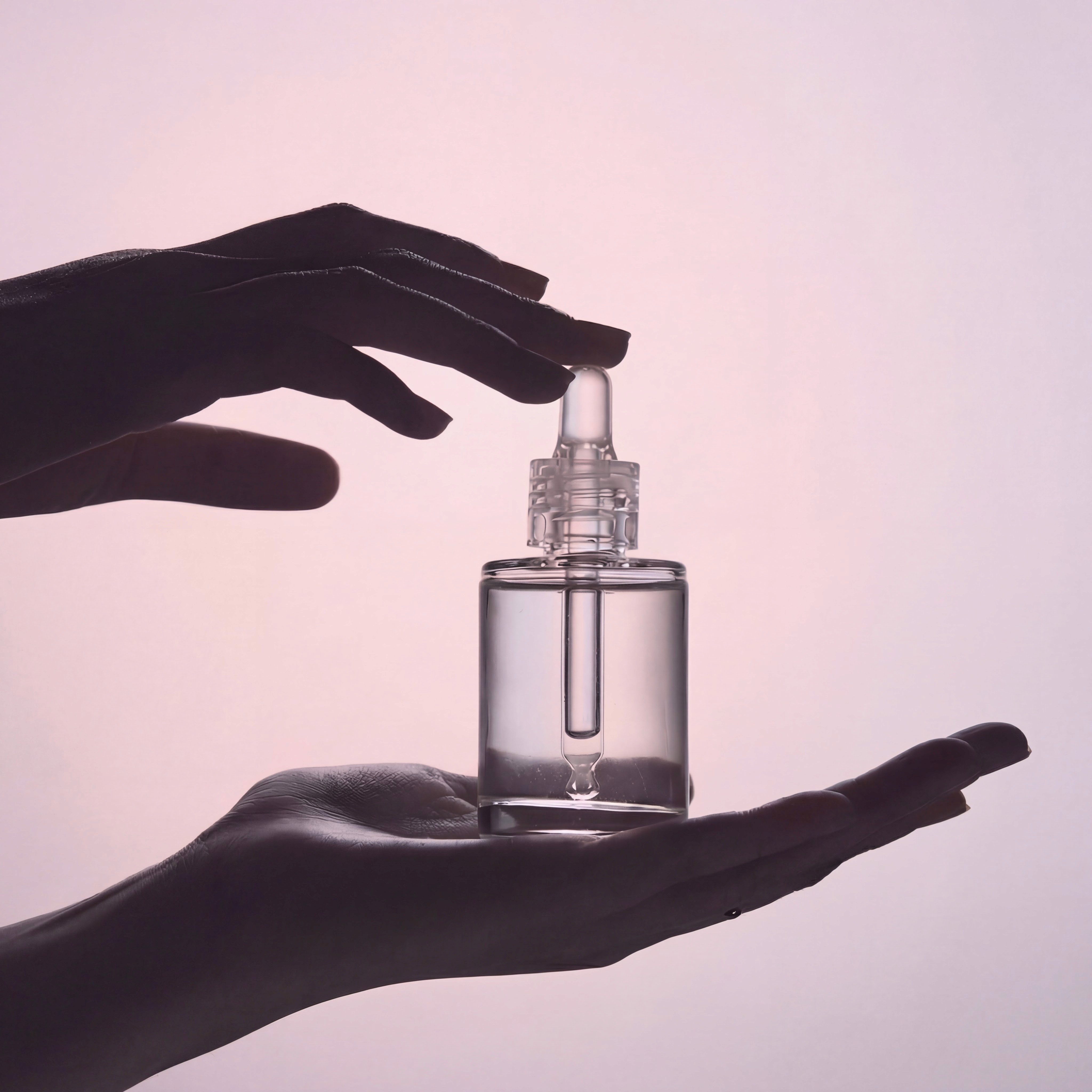

The topic is short and compact
Mineral filters and iron oxides compete for the same dispersion. If they agglomerate, the measurable sun protection factor decreases and the texture becomes gritty.
With ISO 23675:2024, an in vitro method has been available since December 2024 that determines the sun protection factor without test subjects.
The shear force input cannot be directly transferred from a laboratory homogenizer to a 1,000-liter batch: too much destroys the thickener, too little causes pigments to agglomerate.
So läuft die Entwicklung bei Labtree
1
Konzeptionierung
2
Bemusterung – Standardmuster in 24 h
3
Individualisierung
4
Prototyping
5
Produktion
White Label 2–3 Monate · Private Label 3–6 Monate · Produktion ab 1.000 Stück
A tinted SPF serum must meet two requirements at the same time, which technically stand in each other's way. Sun protection requires an even, gap-free distribution of UV filters on the skin. The tint requires a defined amount of pigment, which also claims space in exactly the same area.
Both solids, mineral filters such as titanium dioxide or zinc oxide and coloring iron oxides, must be stably dispersed in the same phase. They compete for the same dispersant and the same shear energy. This competition is the very core of the development.
Two solid systems in one phase, with mutual competition for dispersants.
The sun protection requires proof, the shade requires approval.
Both requirements are tested on the same end product, not separately.
Why tinted SPF products are two formulations in one
A tinted SPF serum must meet two requirements at the same time, which technically stand in each other's way. Sun protection requires an even, gap-free distribution of UV filters on the skin. The tint requires a defined amount of pigment, which also claims space in exactly the same area.
Both solids, mineral filters such as titanium dioxide or zinc oxide and coloring iron oxides, must be stably dispersed in the same phase. They compete for the same dispersant and the same shear energy. This competition is the very core of the development.
Two solid systems in one phase, with mutual competition for dispersants.
The sun protection requires proof, the shade requires approval.
Both requirements are tested on the same end product, not separately.
Dispersion: the actual bottleneck
If the mineral filters agglomerate, gaps form in the protective film. The measured sun protection factor decreases, even though the amount of filter used is mathematically correct. At the same time, the sensory profile changes: the product feels gritty and leaves a visible whitening effect.
Proof is therefore not obtained via the quantity used, but via measurement of the finished product. A formulation with a mathematically sufficient quantity of filter can fail to achieve the claimed factor if the dispersion is incomplete. Surface-treated raw material qualities make dispersion considerably easier.
Agglomerates create gaps in the protective film and reduce the measurable factor.
Surface-treated filter and pigment qualities reduce the tendency to agglomerate.
Document dispersing time and energy input as binding process parameters.
Nuance and texture: avoiding metamerism
Color release is error-prone for tinted products because the assessment often takes place under a single light source. Two samples can appear identical under daylight and differ visibly from each other under store lighting. This effect is called metamerism and can only be ruled out by testing under several standardized light types.
The release should therefore be carried out spectrophotometrically and cover at least the standard light types for daylight and store lighting. A purely visual release is not reliable for a product with pigment and mineral filters.
Testing under several standardized light types instead of a single one.
Spectrophotometric release with defined color difference tolerance.
The whitening effect of the filters shifts the shade and must be taken into account.
The basics of shade release are described in Shade development for make-up.
Proof of the sun protection factor
The claimed sun protection factor must be proven. For a long time, the in vivo test according to ISO 24444 was the only recognized method for this, in which the factor is determined on volunteers via skin redness. It is still considered an internationally recognized reference, but is complex and time-consuming.
Since December 2024, ISO 23675 has provided a fully in vitro method. It determines the factor using a double-plate method on PMMA plates, without test subjects. In addition, ISO 23698 is a hybrid method based on diffuse reflectance spectroscopy.
ISO 24444: In vivo testing on volunteers, still a recognized reference.
ISO 23675:2024: In vitro double-plate method, without test subjects, highly reproducible.
ISO 23698:2024: Hybrid method with diffuse reflectance spectroscopy.
The choice of test standard should be part of the early planning phase, as it determines lead time and costs. Any formulation change after testing invalidates the proof.
Stability and packaging compatibility
Pigment-containing emulsions tend to sediment. If filters or pigments settle over the storage period, both the shade and the actual protection change with the first application. The test is therefore carried out via accelerated storage at forty degrees Celsius for twelve weeks in the final container.
The packaging is not a minor aspect. Pigments can accumulate on plastic surfaces, and translucent containers promote the oxidation of sensitive oil phase components. An airless system also protects against recontamination and oxygen entry.
Accelerated storage at forty degrees Celsius for twelve weeks in the final container.
Sedimentation control, as settling changes the shade and protective effect.
Opaque or airless containers against oxidation and recontamination.
The full scope of testing is described in Stability and safety testing.
Scale-up: Shear force is not transferable
In the laboratory, a rotor-stator homogenizer easily achieves the shear rates required for dispersion. In a vacuum emulsifier with a capacity of one thousand liters, the same energy input per volume is much more difficult to achieve and, moreover, is unevenly distributed.
This results in a narrow process window. Too high a shear force input destroys the polymer thickeners and the emulsion loses its viscosity. Too low an input causes filters and pigments to agglomerate, which deteriorates both the nuance and the protective effect at the same time. The order of addition in the vessel is just as decisive as the speed.
Energy input per volume decreases with batch size and is distributed more unevenly.
Too much shear force destroys the thickener, too little causes solids to agglomerate.
Bindingly define and document the dispersion sequence in the vessel.
How this transition can be secured is shown in Scaling via the pilot batch.
A tinted SPF serum is regulatory-wise one single product, but it must fulfill the requirements of both categories. For sun protection, the approved filters and their maximum concentrations according to Annex VI of Regulation (EC) No 1223/2009 must be complied with; for the tint, the specifications for colorants according to Annex IV apply.
Both aspects flow into the same product information file and the same safety report. Part A contains the safety data including exposure assessment, while Part B contains the assessment by the safety assessor. The SPF test report is an integral part of the dossier and must match the final formulation.
Observe approved UV filters and maximum concentrations according to Annex VI.
Colorants according to Annex IV, including purity requirements.
SPF test report as part of the product information file.
CPNP notification prior to placing on the market.
The complete process is described in EU Cosmetics Regulation, CPNP and PIF.
More useful links
FAQ
What makes a tinted SPF serum technically difficult?
Mineral UV filters and coloring iron oxides must be stably dispersed in the same phase, competing for the same dispersing agent and shear energy. If the dispersion is not fully successful, the protective effect and color fidelity will decrease at the same time.
Why does the sun protection factor decrease even though the amount of filter is correct?
Because protection depends on distribution, not just on the quantity. Agglomerated filter particles leave gaps in the protective film. The measured factor is then lower than the mathematically expected value, which is why the verification must be carried out on the finished product.
What changes with ISO 23675:2024?
The standard published in December 2024 describes a double-plate method that determines the sun protection factor entirely in vitro on PMMA plates. This eliminates the need for testing on human subjects. ISO 24444 remains internationally recognized as the in vivo reference.
How is the shade reliably released?
Spectrophotometrically and under multiple standardized light sources. Two samples may appear identical under daylight but differ under retail lighting. This metamerism effect can only be ruled out by measuring under multiple light sources, not through visual assessment.
Which packaging is suitable?
An opaque or airless container. It protects sensitive oil phase components from oxidation and prevents recontamination. Additionally, it should be checked whether pigments accumulate on the inner surface, as this can alter the shade over the storage period.
What proof does the EU require?
The product must comply with the approved UV filters according to Annex VI and the colorant specifications according to Annex IV of Regulation (EC) No 1223/2009. The SPF test report, safety report with Part A and Part B, and the CPNP notification must be included in the same Product Information File (PIF).