The topic is short and compact
The oil blend determines sensory profile, absorption rate and price point. 2 to 7 oils are typical.
Scent is often the decising purchase criterion for body oil, because the composition lasts longer than with lotions.
With formulation basis and early validation of antioxidant protection and packaging: 2 to 4 months to market launch.
So läuft die Entwicklung bei Labtree
1
Konzeptionierung
2
Bemusterung – Standardmuster in 24 h
3
Individualisierung
4
Prototyping
5
Produktion
White Label 2–3 Monate · Private Label 3–6 Monate · Produktion ab 1.000 Stück
The selection and combination of care oils is the first strategic decision. It determines the sensory profile, absorption rate, inherent scent, and price point.
Jojoba oil (10 to 60 percent): very similar to skin lipids, quickly absorbed, virtually no inherent scent. Versatile base for many body oil concepts.
Squalane (10 to 40 percent): very light oil of plant origin, ideal for fast-absorbing concepts, odorless, high-quality.
Argan oil (5 to 20 percent): nourishing active ingredient character, light inherent scent, premium positioning.
Almond oil (10 to 40 percent): soft skin feel, slightly nutty inherent scent, cost-effective.
Avocado or Macadamia oil (5 to 15 percent): rich, nourishing, slower absorption.
Caprylic/Capric Triglycerides (10 to 40 percent): very light, odorless carrier oil, improves absorption behavior in mixtures.
Premium body oils typically combine 4 to 7 oils. Mass-market variants work with 2 to 3 oils and a higher proportion of light carrier oils.
Anyone planning the journey from the idea to the finished batch will find the overview under Kosmetik entwickeln lassen.
Which oil blend carries which brand promise
The selection and combination of care oils is the first strategic decision. It determines the sensory profile, absorption rate, inherent scent, and price point.
Jojoba oil (10 to 60 percent): very similar to skin lipids, quickly absorbed, virtually no inherent scent. Versatile base for many body oil concepts.
Squalane (10 to 40 percent): very light oil of plant origin, ideal for fast-absorbing concepts, odorless, high-quality.
Argan oil (5 to 20 percent): nourishing active ingredient character, light inherent scent, premium positioning.
Almond oil (10 to 40 percent): soft skin feel, slightly nutty inherent scent, cost-effective.
Avocado or Macadamia oil (5 to 15 percent): rich, nourishing, slower absorption.
Caprylic/Capric Triglycerides (10 to 40 percent): very light, odorless carrier oil, improves absorption behavior in mixtures.
Premium body oils typically combine 4 to 7 oils. Mass-market variants work with 2 to 3 oils and a higher proportion of light carrier oils.
Anyone planning the journey from the idea to the finished batch will find the overview under Kosmetik entwickeln lassen.
Fast-absorbing or nourishing
The second strategic decision concerns the desired sensory profile. Body oils can be positioned on two axes.
Fast-absorbing body oils (dry oils): high proportion of squalane, caprylic/capric triglycerides, or jojoba. Hardly moisturizing, suitable for everyday use. Brand promise: daily use, no sticky feel, suitable for sports and clothing.
Nourishing body oils: higher proportion of avocado, macadamia, argan, or unrefined vegetable oils. Longer absorption time, distinct caring experience. Brand promise: care ritual, dry skin, aromatherapy.
Hybrid concepts: lightweight carrier oil base with targeted active ingredient oils, balancing absorption speed and the feeling of nourishment.
The axis decision should fit the target audience and the occasion of use. An after-shower oil has different requirements than a massage oil.
Scent as a central sensory lever
With body oil, the scent is often the decisive purchase criterion. Unlike lotions, scents in oils linger longer because the carrier medium retains the fragrance notes better.
Perfume oil concentration: 0.3 to 1.2 percent, depending on brand positioning. Body oils tend to carry higher scent concentrations than lotions.
Essential oils: supplement or replace perfume oils in natural cosmetics concepts. Concentration 0.2 to 1 percent, skin compatibility test important.
Scent progression: in oils, the scent unfolds more slowly and lasts longer. This allows for more creative freedom during composition.
Fragrance-free variants: for sensitive skin types, often with refined odorless carrier oils such as squalane.
The scent selection is to be tested iteratively during the sampling phase, because the effect can only be truly assessed in connection with skin warmth.
Packaging and Application Ritual
Packaging for body oil is part of the brand ritual. It must offer protection against light and oxidation while at the same time conveying a premium impression.
Glass bottle with pump 100 ml to 200 ml: Premium standard. Dark or frosted glass protects against light oxidation. Pump for hygienic dispensing.
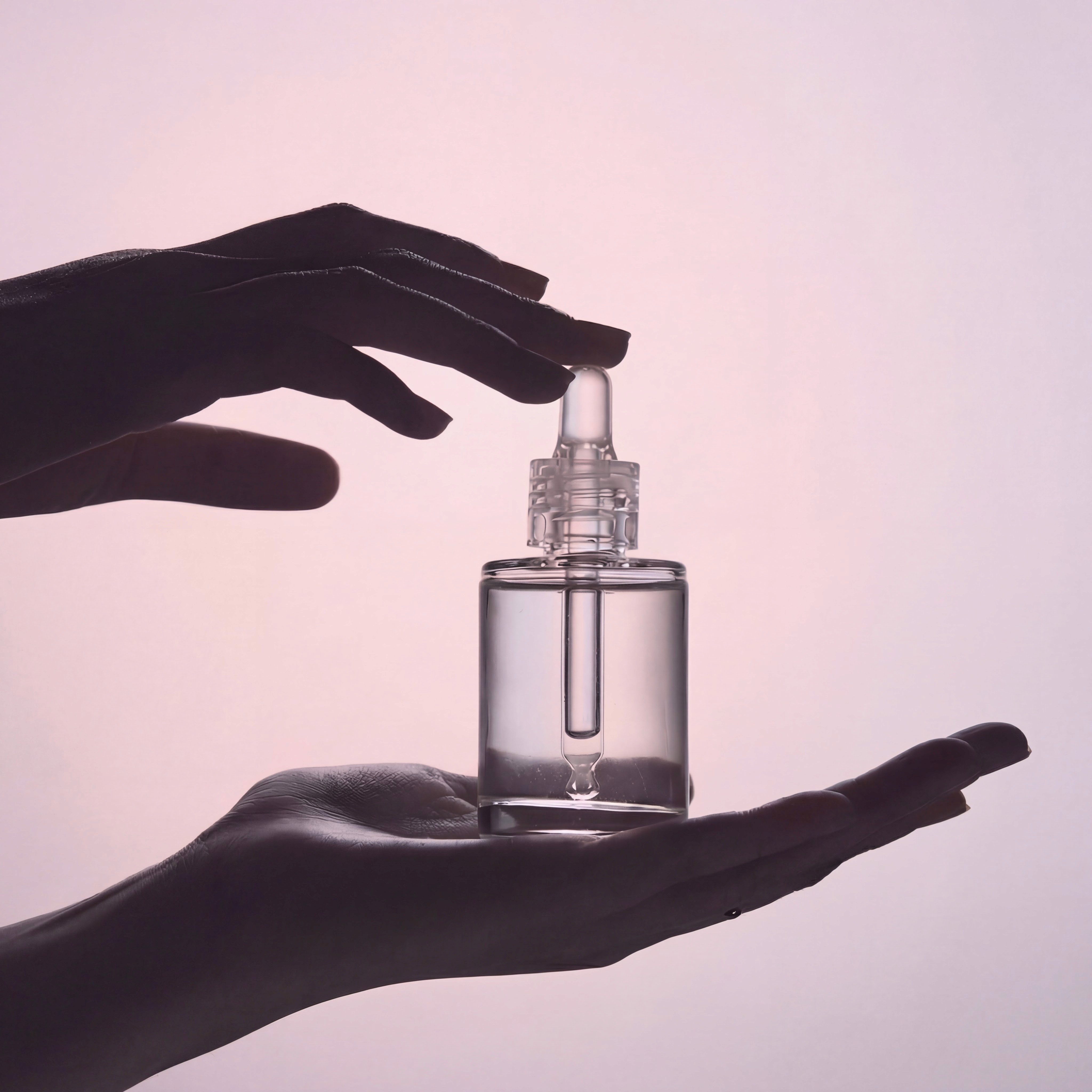
Glass bottle with pipette 30 ml to 100 ml: Ritualized application experience, suitable for premium and wellness positionings.
Glass bottle with spray attachment: Finest distribution, easy application. Requires low-viscosity oils.
Secondary packaging: Folding box with haptic refinement enhances the premium perception on the shelf.
Vitamin E (tocopherol) as an antioxidant in the oil significantly extends stability, especially in the case of plant oils sensitive to oxidation.
Time and cost variables
White Label based on pre-qualified formulation: 2 to 3 months, unit costs from approx. 4 to 12 EUR (depending on oil blend, glass bottle, pump type, batch size)
Individual new development: 3 to 6 months, higher initial costs for stability testing, fragrance alignment, and oxidation stability
Typical MOQ: 1,500 to 5,000 units with standard glass bottle, higher for special packaging with pipette or spray
At Labtree, pre-qualified body oil formulations in different oil profiles serve as a starting point. Brands see early on which base matches the planned sensory profile and fragrance concept.
In-depth sources: The legal basis for all cosmetic products marketed in the EU is the EU Cosmetics Regulation (EC) No. 1223/2009. In Germany, the health assessment of ingredients is the responsibility of the Federal Institute for Risk Assessment (BfR). Industry information and market data are published by the German Cosmetic, Toiletry, Perfumery and Detergent Association (IKW).
The 5-phase process for a body oil
Conceptualization: Selection of the oil blend, positioning on the spectrum from fast-absorbing to nourishing, scent direction, and packaging based on brand promise, target audience, and price point. Matching with a suitable formulation base from the Labtree pool.
sampling: Standard samples of pre-qualified formulations are shipped from the sample warehouse within 24 hours, free of charge for customers. Initial sensory evaluation on real products.
Individualization: Targeted adjustment of oil ratios, active ingredient oils, fragrance composition. Iterative sample variants until the sensory profile and scent are a perfect match.
Prototyping: Test batch in production-like size, including testing of the final glass bottle with pump or pipette. In parallel, packaging, design, regulatory requirements, and production feasibility are taken into account early on, rather than being addressed only after final formulation approval.
Production: Scaling to the final batch size, transition to routine production. Because production feasibility was already considered during the prototyping phase, the final step is carried out in a coordinated manner.
Related articles: Have body lotion produced · Have body butter produced · Have lip oil produced
Own body oil formulations in the pool: Do oil bases already exist in different sensory profiles, or does every development start from scratch?
Own laboratory: Can oil blending and fragrance adjustments be carried out in-house, or do they have to be outsourced?
Sampling speed: Standard samples within 24 hours is a realistic benchmark. At Labtree, shipping is also free of charge.
Experience with oxidation-sensitive plant oils: Stability is a key issue with body oils. Antioxidant strategy and light-protective packaging are closely linked.
Scalability: From test batch to large-scale production without any interface breaks.
Having body oil produced is a well-planable project if strategic decisions (oil blend, sensory profile, fragrance, packaging) are made early and are based on a pre-qualified formulation basis. Anyone who considers oxidation stability and regulatory preparation in parallel with the formulation can achieve a market launch in 2 to 4 months.
More useful links
FAQ
Does Labtree have its own laboratory?
Yes. Labtree has its own development expertise, including a laboratory. This means that formulations can not only be selected, but specifically developed, tested, and adjusted. Additionally, smaller test batches can be produced in-house in order to validate products early on in real conditions and safely transfer them to production.
Which nourishing oils are suitable for a body oil?
Jojoba and squalane for fast-absorbing concepts, almond and argan for balanced care, avocado and macadamia for nourishing variations. Caprylic/capric triglycerides are a high-quality, odorless carrier oil. The blend should match the sensory profile and the target audience.
How can oxidation stability be ensured?
Antioxidants such as vitamin E (tocopherol, 0.2 to 0.8 percent) are standard. Light-protective packaging (dark or frosted glass) provides additional protection. For vegetable oils sensitive to oxidation, the choice of raw material quality (fresh pressing, nitrogen protection in the drum) is also relevant.
How long does it take to develop a body oil?
For White Label on a pre-qualified formulation basis: 2 to 3 months. Individual new development: 3 to 6 months. Crucial factors are fragrance iterations, oxidation stability, and the selection of the final packaging with a pump or pipette.
What minimum quantity is realistic?
For standard glass bottles, 1,500 to 5,000 units per product; for pipette or spray concepts, correspondingly higher. Test batches from approx. 1,000 to 2,000 units are possible for market validation.
How much does it cost to produce a body oil?
Project-dependent. Unit costs for white label with standard glass bottles are typically 4 to 12 EUR for medium batch sizes. Initial costs include stability tests, skin compatibility tests, and regulatory documentation. Premium oils like cold-pressed argan oil and high-quality dropper bottles drive up the unit costs.