The topic is short and compact
Peptide class and concentration determine the mechanism of action and brand promise—the most important first decision.
pH stability is crucial, typically 5.0 to 6.5. Outside of this range, the peptide loses activity.
With formulation basis and early parallel consideration of packaging and approval: 2 to 4 months to market launch.
So läuft die Entwicklung bei Labtree
1
Konzeptionierung
2
Bemusterung – Standardmuster in 24 h
3
Individualisierung
4
Prototyping
5
Produktion
White Label 2–3 Monate · Private Label 3–6 Monate · Produktion ab 1.000 Stück
The choice of peptide class is the first strategic decision. It determines the mechanism of action, reasonable concentration and possible marketing claim.
Signal peptides (e.g. Matrixyl 3000, Palmitoyl Tripeptide-1): stimulate collagen synthesis and skin regeneration. Concentrations 3 to 10 percent (active ingredient solution). Brand promise: anti-aging, wrinkle reduction.
Carrier peptides (e.g. GHK-Cu, copper peptides): transport trace elements into the skin, promote wound healing. Concentrations 0.5 to 3 percent. Brand promise: skin regeneration, post-operative care.
Neurotransmitter-blocking peptides (e.g. Argireline / Acetyl Hexapeptide-8): reduce muscle contraction on the skin surface. Concentrations 5 to 10 percent. Brand promise: expression lines, Botox alternative.
Enzyme-inhibiting peptides (e.g. Soybean Peptide): inhibit collagen-degrading enzymes. Concentrations 1 to 5 percent. Brand promise: skin firmness, anti-aging.
Structural peptides (e.g. Palmitoyl Pentapeptide-4 / Matrixyl): mimic collagen fragments, trigger a repair response. Concentrations 3 to 8 percent. Brand promise: visible skin structure improvement.
Many brands combine several peptide classes in one serum (peptide complex) to address different action pathways simultaneously.
The complete path from the formulation to series production is described on the page Have cosmetics developed and manufactured.
Which peptide class carries which brand promise
The choice of peptide class is the first strategic decision. It determines the mechanism of action, reasonable concentration and possible marketing claim.
Signal peptides (e.g. Matrixyl 3000, Palmitoyl Tripeptide-1): stimulate collagen synthesis and skin regeneration. Concentrations 3 to 10 percent (active ingredient solution). Brand promise: anti-aging, wrinkle reduction.
Carrier peptides (e.g. GHK-Cu, copper peptides): transport trace elements into the skin, promote wound healing. Concentrations 0.5 to 3 percent. Brand promise: skin regeneration, post-operative care.
Neurotransmitter-blocking peptides (e.g. Argireline / Acetyl Hexapeptide-8): reduce muscle contraction on the skin surface. Concentrations 5 to 10 percent. Brand promise: expression lines, Botox alternative.
Enzyme-inhibiting peptides (e.g. Soybean Peptide): inhibit collagen-degrading enzymes. Concentrations 1 to 5 percent. Brand promise: skin firmness, anti-aging.
Structural peptides (e.g. Palmitoyl Pentapeptide-4 / Matrixyl): mimic collagen fragments, trigger a repair response. Concentrations 3 to 8 percent. Brand promise: visible skin structure improvement.
Many brands combine several peptide classes in one serum (peptide complex) to address different action pathways simultaneously.
The complete path from the formulation to series production is described on the page Have cosmetics developed and manufactured.
Stability, pH, and carrier system
Peptides are chemically sensitive. They react to pH fluctuations, high temperatures, and certain preservatives. Stability arises from the interplay of the carrier system, pH buffer, antioxidants, and packaging.
Structured approach:
pH range: typically 5.0 to 6.5, depending on the peptide class. Outside of this range, the peptide loses activity.
Stressed stability: 4 weeks at 40 degrees, assessment of active ingredient content and appearance
Real-time stability: 12 to 24 months at room temperature and 5 degrees
Skin compatibility test (HRIPT): with 50 test subjects for specific efficacy claims
Packaging and Application Ritual
For peptide serums, packaging is not a primary stability lever (unlike with vitamin C or retinol), but is part of the brand positioning:
Airless pump: prevents air contact, premium sensory profile, protects sensitive peptides. Higher unit costs.
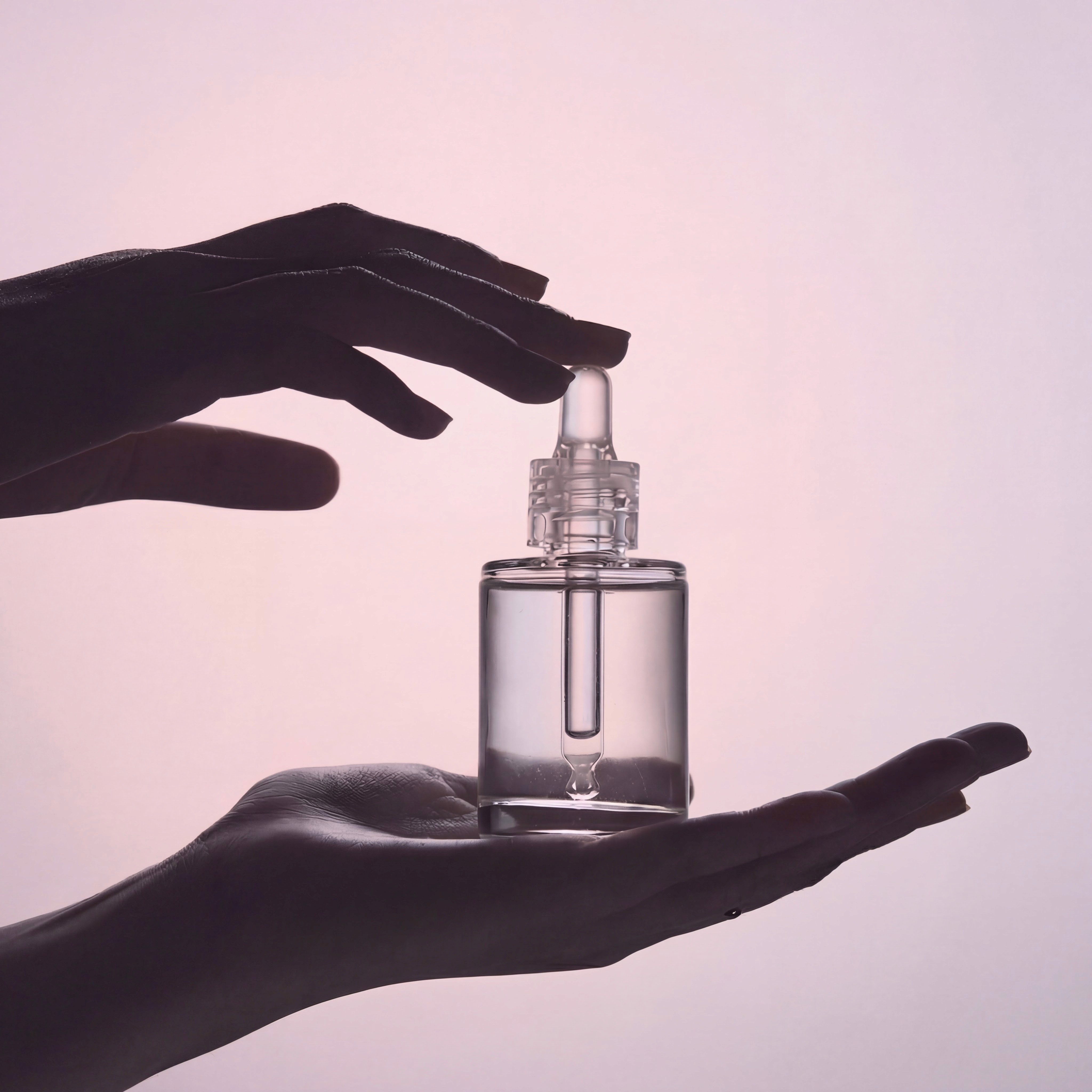
Pipette bottle made of dark glass: classic serum ritual, good appearance. Slightly more air contact during application.
Pump dispenser: hygienic, suitable for everyday use, medium costs.
Active ingredient combinations with real added value
Peptides combine well with most skincare active ingredients. Three proven combinations:
Peptides + Hyaluronic Acid: Skin texture improvement combined with hydration. Very broad target audience.
Peptides + Niacinamide: Anti-aging plus skin barrier strengthening. Suitable for sensitive skin types.
Peptides + Retinol (in separate products or buffered formulations): Combined anti-aging effect via different pathways. Premium positioning.
Direct combinations with high vitamin C concentrations in the same formulation (pH conflict) are not recommended. These active ingredients belong in separate products.
Time and cost variables
White label based on pre-qualified formulation: 2 to 3 months, unit costs from approx. 5 to 9 EUR (depending on peptide class, concentration, packaging, batch size)
Individual new development: 3 to 6 months, higher initial costs for stability testing and, if applicable, efficacy studies for specific marketing claims
Typical MOQ: 1,000 to 3,000 units with standard packaging, higher for airless pumps
At Labtree, pre-qualified peptide formulations in different classes and concentrations serve as a starting point. Brands see early on which base suits the planned positioning.
In-depth sources: The legal basis for all cosmetic products marketed in the EU is the EU Cosmetics Regulation (EC) No. 1223/2009. In Germany, the health assessment of ingredients is the responsibility of the Federal Institute for Risk Assessment (BfR). Industry information and market data are published by the German Cosmetic, Toiletry, Perfumery and Detergent Association (IKW).
The 5-phase process for a peptide serum
Conceptualization: Selection of the peptide class, concentration and active ingredient combination based on brand promise, target group and price point. Assignment to a matching formulation base from the Labtree pool.
sampling: Standard samples of pre-qualified formulations are shipped from the sample warehouse within 24 hours, free of charge for customers. Initial sensory evaluation on real products.
Individualization: Targeted adjustment of peptide concentration, pH buffering, accompanying active ingredients, fragrance and sensory profile.
Prototyping: Test batch in production-like size. In parallel, packaging, design, regulatory requirements and production capability are considered early on, instead of only being addressed after final formulation approval.
Production: Scaling to final batch size, transition to routine production. Because production capability was already considered during the prototyping phase, the final step is coordinated.
Related articles: Have Vitamin C Serum produced · Have Hyaluronic Acid Serum produced · Strategic active ingredient choice
In-house peptide formulations in the pool: Do stability-tested peptide bases already exist in different classes and concentrations, or does every development start from scratch?
In-house laboratory: Can pH and active ingredient adjustments be made in-house, or do they have to be outsourced externally?
Sampling speed: Standard samples within 24 hours is a realistic benchmark. At Labtree, shipping is also free of charge.
Early parallel consideration: Packaging selection, stability protocol, and regulatory preparation should run parallel to the formulation adjustment, instead of only being addressed after final approval.
Scalability: From the test batch to large-scale production without interface disruption.
Having peptide serum produced is a well-plannable venture if the strategic decisions (peptide class, concentration, carrier system) are made early on and are based on a pre-qualified formulation. Anyone who considers packaging, stability, and regulatory preparation in parallel with the formulation can achieve a market launch in 2 to 4 months.
More useful links
FAQ
Does Labtree have its own laboratory?
Yes. Labtree has its own development expertise, including a laboratory. This means that formulations can not only be selected, but specifically developed, tested, and adjusted. Additionally, smaller test batches can be produced in-house in order to validate products early on in real conditions and safely transfer them to production.
Which peptide class is the right one?
That depends on the brand promise. Signal peptides (e.g., Matrixyl) for general anti-aging effects, Argireline for expression lines, copper peptides for skin regeneration. Many modern serums combine several peptide classes in one complex.
Which concentration makes sense?
Typically 2 to 10 percent peptide solution in the final product, depending on the class. Higher concentrations do not automatically yield a stronger effect because receptor saturation is limited.
How long does the development of a peptide serum take?
For White Label on a pre-qualified formulation basis: 2 to 3 months. Individual new development: 3 to 6 months. Decisive factors are stability tests and, if applicable, proof of efficacy for specific marketing claims.
What minimum quantity is realistic?
For standard packaging 1,000 to 3,000 pieces per product, for airless pumps 2,500 to 5,000 pieces (packaging MOQ prevails). Test batches from approx. 1,000 to 2,000 pieces are possible for market validation.
How much does a peptide serum cost to produce?
Project-dependent. Unit costs for White Label with standard packaging are typically 5 to 9 EUR with a medium batch size. Initial costs include stability tests, skin compatibility tests, and regulatory documentation. For Private Label with an individual active ingredient combination, the initial costs are higher.