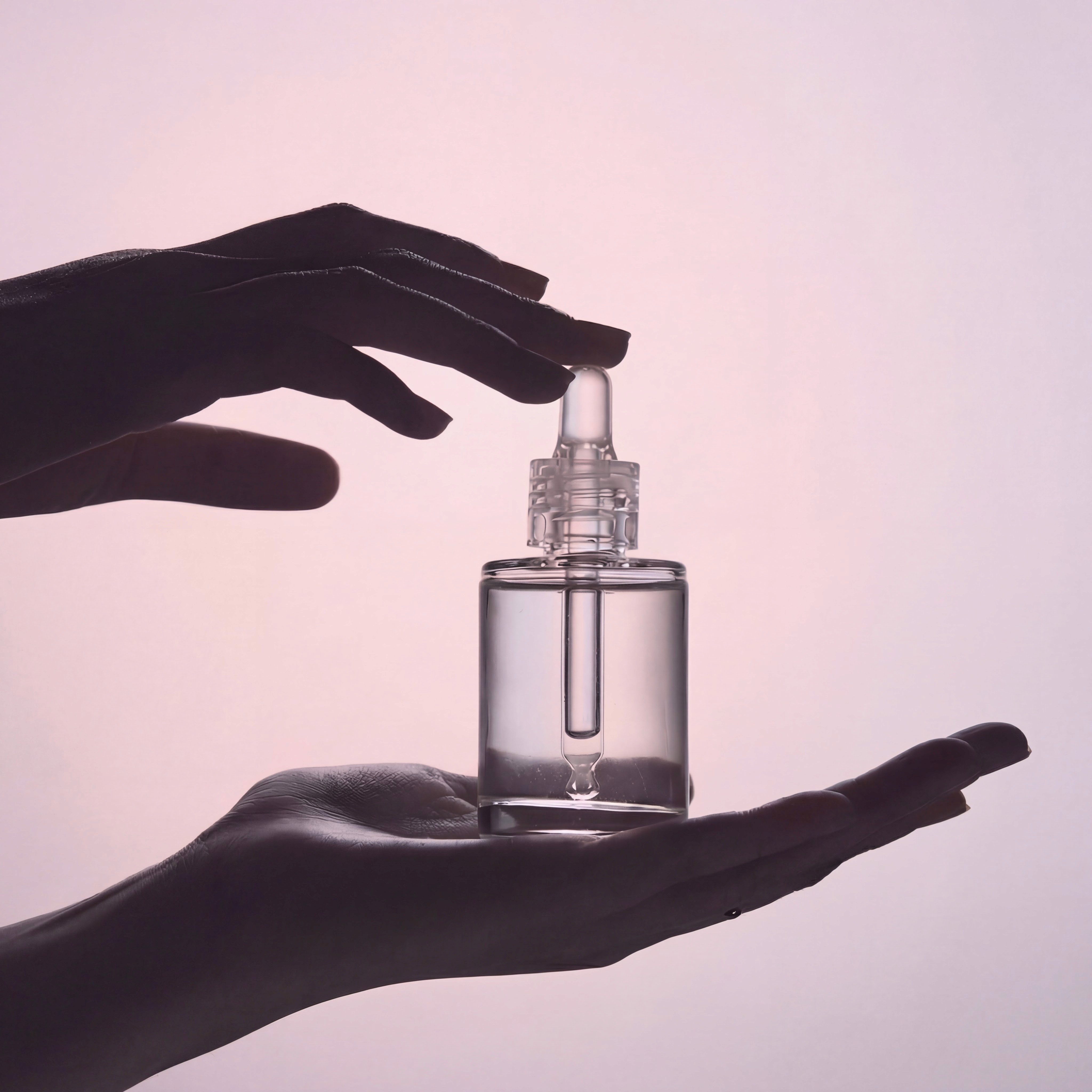
The topic is short and compact
A rich texture and higher active ingredient concentrations are possible and useful at night because there is no UV exposure.
Lipid structure (ceramides, squalane) strengthens the skin barrier and is a key lever for night care.
With formulation basis and early parallel consideration: 2 to 4 months to market launch.
So läuft die Entwicklung bei Labtree
1
Konzeptionierung
2
Bemusterung – Standardmuster in 24 h
3
Individualisierung
4
Prototyping
5
Produktion
White Label 2–3 Monate · Private Label 3–6 Monate · Produktion ab 1.000 Stück
The choice of night formulation is the first strategic decision. It determines the level of care, skin feel, and brand positioning.
W/O emulsion (water-in-oil): rich, high lipid content, protective film overnight. Brand promise: intensive regeneration, dry and mature skin.
Rich O/W emulsion: creamy, easily spreadable, medium richness. Brand promise: balanced night care, normal skin.
Lamellar structures (ceramide complexes): mimic the skin barrier, targeted lipid replenishment. Brand promise: barrier strengthening, sensitive skin.
Sleeping Mask / Overnight Mask: gel-like to creamy texture, absorbing, often with repair complex. Brand promise: overnight treatment, K-beauty inspired.
Anhydrous balm: water-free, very rich, highest active ingredient concentration possible. Brand promise: premium special care.
The complete path from the formulation to series production is described on the page Kosmetik entwickeln und herstellen lassen.
Which night formulation carries which brand promise
The choice of night formulation is the first strategic decision. It determines the level of care, skin feel, and brand positioning.
W/O emulsion (water-in-oil): rich, high lipid content, protective film overnight. Brand promise: intensive regeneration, dry and mature skin.
Rich O/W emulsion: creamy, easily spreadable, medium richness. Brand promise: balanced night care, normal skin.
Lamellar structures (ceramide complexes): mimic the skin barrier, targeted lipid replenishment. Brand promise: barrier strengthening, sensitive skin.
Sleeping Mask / Overnight Mask: gel-like to creamy texture, absorbing, often with repair complex. Brand promise: overnight treatment, K-beauty inspired.
Anhydrous balm: water-free, very rich, highest active ingredient concentration possible. Brand promise: premium special care.
The complete path from the formulation to series production is described on the page Kosmetik entwickeln und herstellen lassen.
Regeneration active ingredients in higher concentration
At night, anti-aging active ingredients can be used in higher concentrations because there is no UV exposure and the skin shows better absorption. Proven active ingredients:
Retinol and retinol derivatives: stimulate cell renewal. Concentrations 0.1 to 1 percent. Photosensitizing, therefore night application is standard.
Peptides: wrinkle smoothing and skin structure. Concentrations 3 to 10 percent (active ingredient solution).
Bakuchiol (plant-based retinol alternative): similar effect to retinol, better tolerated. Concentrations 0.5 to 2 percent.
Niacinamide: skin barrier strengthening, redness reduction. Concentrations 2 to 10 percent.
AHA / BHA (acids): chemical peeling overnight. Concentrations 2 to 10 percent (AHA) or 0.5 to 2 percent (BHA).
Important: Do not combine acids and retinol in the same formulation (pH conflict, high potential for irritation). These active ingredients belong in separate products or in a pH-buffered special formulation.
Lipid structure and skin barrier
Night is the most important phase for lipid accumulation. A night cream should replenish the skin's own lipids and strengthen the barrier. Three proven lipid components:
Ceramides: central lipid building blocks of the skin barrier. Concentrations 0.5 to 2 percent. Brand promise: barrier repair.
Squalane: skin's own lipid (plant source: olive, sugarcane). Concentrations 2 to 10 percent. Brand promise: skin's own care.
Shea butter and botanical oils: nourishing, protective film. Concentrations, depending on the formulation, 3 to 15 percent.
Lamellar structures combine ceramides with cholesterol and free fatty acids in a skin-identical ratio (typically 3:1:1). This strengthens the barrier particularly effectively.
Packaging for rich textures
The packaging of a night cream balances premium optics and active ingredient stability:
Glass jar: classic for rich night creams, premium appearance. More air contact during application.
Airless pump: optimal stability for formulations containing retinol or vitamin C. Premium positioning. Higher unit costs.
Tube: hygienic, suitable for everyday use, appropriate for medium textures.
Dispenser with pump head: precise dosing, suitable for richer O/W creams.
Time and cost variables
White label on a pre-qualified formulation basis: 2 to 3 months, unit costs from approx. 3 to 8 EUR (depending on active ingredient system, packaging, batch size)
Individual new development: 3 to 6 months, higher initial costs for stability tests, skin compatibility studies and, if applicable, proof of efficacy
Typical MOQ: 1,000 to 3,000 units with standard packaging, higher with airless pumps
At Labtree, pre-qualified night cream formulations in different bases and active ingredient concentrations serve as a starting point. Brands see early on which base fits their planned positioning.
In-depth sources: The legal basis for all cosmetic products marketed in the EU is the EU Cosmetics Regulation (EC) No 1223/2009. In Germany, the health assessment of ingredients lies with the Federal Institute for Risk Assessment (BfR). Industry information and market data are published by the German Cosmetic, Toiletry, Perfumery and Detergent Association (IKW).
The 5-phase process for a night cream
Conceptualization: Selection of the night formulation, active ingredient combination, and lipid structure based on brand promise, target group, and price point. Allocation to a suitable recipe base from the Labtree pool.
sampling: Standard samples of pre-qualified recipes are shipped from the sample warehouse within 24 hours, free of charge for customers. Initial sensory evaluation on real products, especially skin feel the morning after application.
Individualization: Targeted adjustment of active ingredient concentration, lipid ratio, sensory profile, and fragrance. Iterative sample variants until effect and skin compatibility are balanced.
Prototyping: Test batch in production-near size. In parallel, packaging, design, regulatory requirements, and production capability are considered early, instead of being addressed only after the final recipe release.
Production: Scaling to final batch size, transition to routine production. Because production capability was already considered in the prototyping phase, the final step takes place in a coordinated manner.
Related articles: Have anti-aging cream produced · Have face cream produced · Have retinol serum produced
In-house night cream formulations in the pool: Do stability-tested bases with retinol, peptides, or ceramides already exist, or does every development start from scratch?
In-house laboratory: Can active ingredient and lipid adjustments be made in-house, or do they have to be outsourced externally?
Sampling speed: Standard samples within 24 hours is a realistic benchmark. At Labtree, shipping is also free of charge.
Early parallel consideration: Packaging selection, stability protocol, and regulatory preparation should run parallel to the formulation adjustment, instead of being addressed only after final approval.
Scalability: From the test batch to large-scale series without interface disruption.
Having night cream produced is a project that can be planned well if the strategic decisions (texture, regenerating active ingredients, lipid structure) are made early and are based on a pre-qualified formulation base. Anyone who considers packaging and regulatory preparation in parallel with the formulation can achieve market launch within 2 to 4 months.
More useful links
FAQ
Does Labtree have its own laboratory?
Yes. Labtree has its own development expertise, including a laboratory. This means that formulations can not only be selected, but specifically developed, tested, and adjusted. Additionally, smaller test batches can be produced in-house in order to validate products early on in real conditions and safely transfer them to production.
What is the difference between a night cream and a day cream?
A night cream is richer, has higher concentrations of active ingredients, and does not contain SPF filters. It utilizes the nightly regeneration phase with more potent anti-aging active ingredients such as retinol or higher-concentrated acids.
Which active ingredients belong in a night cream?
Retinol or retinol derivatives for cell renewal, peptides for smoothing wrinkles, niacinamide for the skin barrier, ceramides and squalane for lipid replenishment. For highly potent active ingredients (retinol above 0.3 percent), buffering with soothing accompanying active ingredients is useful.
How long does it take to develop a night cream?
For White Label based on a pre-qualified formulation: 2 to 3 months. Individual new development: 3 to 6 months. Crucial factors are stability tests, skin compatibility studies and, if applicable, proofs of efficacy.
What minimum quantity is realistic?
For standard packaging 1,000 to 3,000 pieces per product, for airless pumps 2,500 to 5,000 pieces (packaging MOQ prevails). Test batches from approx. 1,000 to 2,000 pieces are possible for market validation.
How much does a night cream cost to produce?
Project-dependent. Unit costs for White Label with standard packaging are typically 3 to 8 EUR for a medium batch size. Initial costs include stability tests, skin compatibility tests, and regulatory documentation. For Private Label with an individual active ingredient combination, the initial costs are higher.